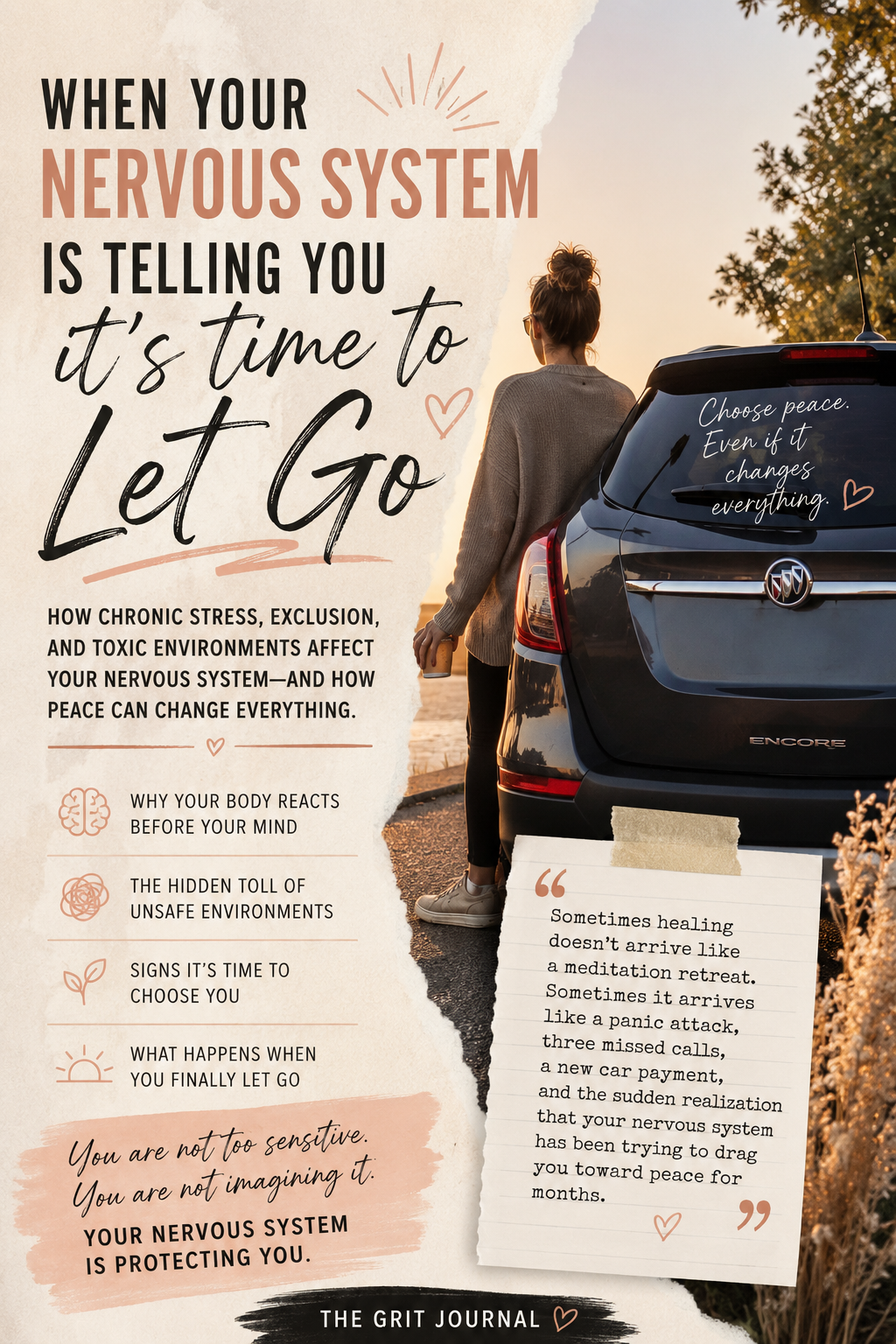
What it sounds like when When Your Nervous System Is Telling You It’s Time to Let Go
If you’ve been white knuckling your way through your days with your shoulders touching your ears and permanent bite marks in your inner lip, that’s your nervous system trying to tell you the truth before your mind is ready to hear it.
It starts small. You’re more tired than usual. More forgetful. More emotional. You start second-guessing yourself. Tasks that once felt easy suddenly feel heavy. Your thoughts get foggy. You overexplain. You replay conversations in your head during the drive home. You wake up anxious before your feet even hit the floor.
Instead of recognizing that something needs to change, we assume the problem must be us. We’re just being over sensitive. That’s the go-to reaction because most of us were taught to push through discomfort instead of listening to it.
Our inner monologue sounds like:
“Maybe I’m overreacting, it wasn’t that big of a deal.”
Or, “I just need to try harder.”
My personal favorite… “I need to “toughen up.”
So we stay.
We stay in environments that make us feel invisible.
In rooms where we are constantly scrutinized.
Dynamics where we shrink ourselves just to avoid conflict, criticism, exclusion, or tension.
The results?
Your nervous system stops treating the environment like a workplace, relationship, friendship, or temporary challenge.
It starts treating it like danger.
Your nervous system doesn’t care whether the threat is physical or emotional. The brain processes social rejection, exclusion, unpredictability, and chronic stress through many of the same survival pathways it uses for actual danger. The amygdala, our brain’s alarm system, begins scanning constantly for what might hurt you next.
That’s why your chest tightens before work.
It’s why you can’t concentrate and your memory feels shot.
Your energy plummets regardless of how many Alani Nu’s you chug.
And overwhelmed and over-stimulated are your new constants.
Wake up call… Regulated people don’t feel this way. But, it’s not your fault. Tell yourself this outloud, right now: I am not lazy. I am not weak. I am not “crazy”.
You are dysregulated.
And there’s a massive difference.
For me, the moment of clarity didn’t arrive peacefully. It never does. If there’s a hard way to do something, you better believe I’m taking that lane. It arrived through anxiety, emotional exhaustion, and the uncomfortable realization that my body had been trying to get my attention for a long time.
I had convinced myself that if I just explained myself better, worked harder, stayed quieter, became more agreeable, or proved my worth enough, things would improve. I was always “on”. In survival mode.
But survival mode has a cost.
The longer we stay in environments that constantly activate our nervous systems, the more disconnected we become from ourselves. We stop creating. We stop trusting our instincts. We stop hearing our own inner voice because all of our energy goes into managing stress, tension, and emotional survival.
When we finally loosen our grip, out of exhaustion or defeat, or whatever it is that FINALLY gets us to that point, there it is. Like a light at the end of a long dark tunnel.
Clarity.
Now, let’s be real, everything isn’t magically fixed overnight. But the noise starts fading just enough for us to hear ourselves again.
In the past few days alone, after finally stepping back and prioritizing my mental health, opportunities started appearing out of nowhere. Conversations reopened. Creative doors opened. Possibilities I couldn’t even see a week ago suddenly became visible again.
And maybe that’s not coincidence.
Maybe sometimes the breakdown is the interruption needed to stop the spin cycle.
Maybe peace feels unfamiliar because chaos became normal.
I believe that my body has been trying to lead me toward something softer, healthier, and more aligned for months.
Most times healing isn’t graceful. The grace is in the awakening.
Sometimes it arrives like panic attacks, missed calls, emotional exhaustion, and the sudden realization that your nervous system has been dragging you toward peace while your mind was still trying to earn belonging in places that were hurting you.
And sometimes healing sounds a lot like this:
“Ma’am, please exit the emotional haunted house, and get in the Buick”
Leave a Reply