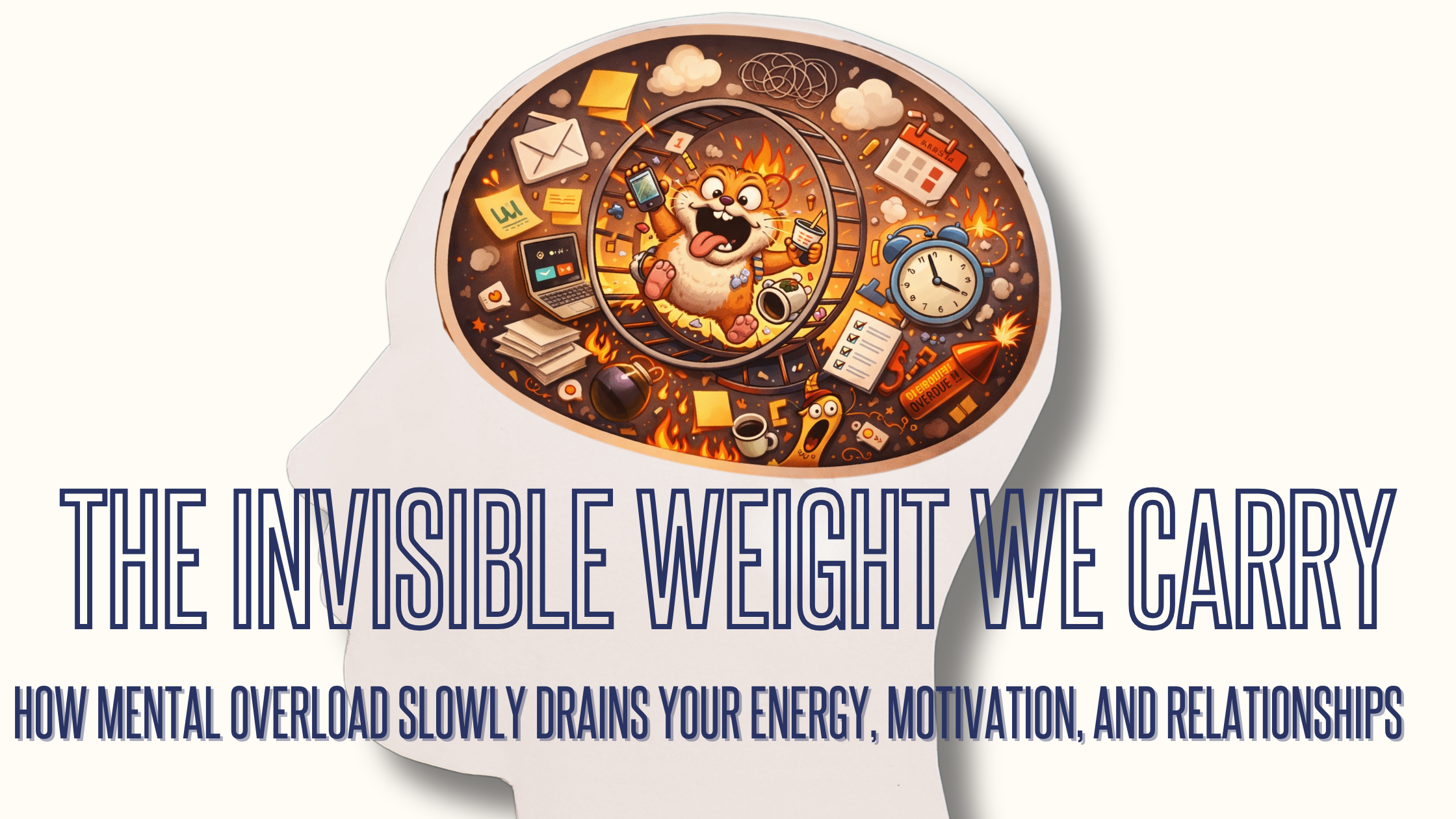
How Mental Overload Slowly Drains Your Energy, Motivation, and Relationships
Most people don’t realize how heavy their life has become until they finally sit still long enough to feel it. I know that’s how it happened for me.
Realization usually doesn’t hit due to the big obvious things. It’s not the dramatic, movie-scene disasters. I’m talking about the quiet weight. The invisible list running in your head at all times. The mental tabs that never close. The conversations you rehearse. The responsibilities you carry, the decisions you’re constantly making, some even before your feet hit the floor in the morning.
It’s the kind of weight nobody sees. Which means nobody talks about it. Which also means most people walk around thinking they’re just “bad at life” when in reality they’re exhausted from carrying an entire invisible workload inside their brain.
And after a while, that kind of exhaustion doesn’t just make you tired. It changes how you move through the world. It makes everything feel harder than it should. Goals start slipping. Motivation disappears. Even the idea of “getting your life together” feels laughable when you’re already using every ounce of energy just to keep things from falling completely apart.
If you feel like you’re constantly running, but still standing in the same place, there’s a good chance you’re overloaded. I call this the hamster wheel effect.
And that’s where the real work begins.
What It Actually Feels Like
Mental Overload, a.k.a. cognitive overload is scientific term used for when your brain has maxed all the way out.
It doesn’t always look or feel the same. Some “typical” red flags:
- Mentally
- Making simple decisions seems impossible
- Lack of focus no matter how hard you try
- Feeling like you are “behind”
- Emotionally
- You’re irritated for no real reason
- Random crying episodes
- Feeling just…numb
- Physically
- Headaches
- Tired, regardless of how much sleep you get
- Muscle tension and body aches
- Behaviorally
- Putting tasks off until the last minute
- Forgetting the tasks all together
- Lack of interest in the things you once loved
Of course that list isn’t inclusive. But, they are the ones that are most common. And, I literally checked all the boxes, so there’s that.
The worst part? You don’t always notice them while they are happening.
Why Motivation Disappears
We tell ourselves “just try harder. Be more disciplined. You just need to focus.”
But our brains don’t work like that. When it’s overloaded, it doesn’t push harder. It pulls back. Because it’s not trying to help you thrive. It’s trying to help you survive. It’s our brains literal job to keep us surviving. When our brains warning signals are flashing it sends the MAYDAY alert to the rest of our body. Literally powering down our whole ass system to keep us alive.
We overwork ourselves silly. Spend all day answering emails, making calls, drafting the proposals, etc. So, at 8pm when we’re trying to “finish that one last thing” it’s much harder and takes way longer. Why?
Our brains have an actual physical part called the amygdala. It’s like the threat center. When we push to hard, it automatically takes over. Imagine trying to write a novel while a smoke alarm is going off. Your brain’s alarm system (the amygdala) thinks the “overload” is a physical threat. It stops caring about your novel and only cares about “putting out the fire.”
We think we’re multitasking like a badass. Handling seventeen situations at one time. But, our brains leave a little piece of the last task stuck to the next one. This part is scientifically called “Attention Residue”
When you jump from Task A to Task B, your brain doesn’t just flip a light switch. A “residue” of your thoughts stays focused on the original task. Even if you’ve moved on, part of your processing power is still stuck on that previous email, conversation, or problem. It’s like leaving thirty seven apps open on your phone and wondering why the phone has slowed down.
This is exactly why multitasking feels so exhausting. It’s not the work itself, it’s the sheer volume of mental clutter you’re dragging from one task to the next.
How mental overload Shows Up in Relationships
Mental overload doesn’t just live in your head. It leaks into your relationships. Shows up during conversations. You are shorter. More reactive and less patient. Your tone, the way you respond… or don’t.
It looks like:
- Your partner leaves one dirty spoon in the sink. You snap.
- You are physically at the table with the family. But mentally, you have thirty seven apps open and zero bandwidth to be part of the conversation.
- The “what do you want for dinner” discussion feels almost paralyzing.
- Your libido is non-existent. Because it is difficult to feel desire when you view intimacy as another “task” to manage.
People tend to take those behaviors personally. So now, not only are you overwhelmed, you’re also misunderstood.
The Invisible Part
The part that is rarely talked about. But needs to be.
Mental overload is invisible. There’s no cast. You don’t get physical scars. There is no clear signal to the people around you that you’re struggling.
So, the expectations of you don’t change. You still need to show up for life. Respond to emails and calls and texts. Function at full capacity all waking hours of the day. Perform as if you don’t have a hamster on a wheel, running his little heart out, in your head.
And over time, that disconnect between how you look and how you feel? It gets heavy.
What Actually Helps
This isn’t where I tell you to “just manage your time better. Drink more water, and do some yoga.” Although, you should probably also do those things. The real problem is the weight. So, the solution is in getting that weight off your shoulders.
That can look like:
- Brain Dumping (Journaling)
- Write down all tasks, worries, and to-dos
- Practice Mindfulness and Grounding
- Meditation and mindfulness techniques (okay maybe I will tell you to “do some yoga”)
- Set Boundaries
- Learn how to say “No.”
- Take Physical Breaks
- Step away from the screen for at least ten minutes
- Prioritize tasks
- List the top 3 tasks for the day and ignore the rest
- Self Care
- Treat your body with the respect it deserves
If you want your brain to be in good shape, you have to take care of it. Resetting your mental bandwidth is crucial for unloading the overload.
The take away
Burnout happens when you have been carrying too much for too long. Mental overload is almost a guarantee when you think you are super-human and can manage all the things, all by yourself.
Of course you’re tired. You are not super-human. (Unless you are, and if that’s the case, please text me. I have so many questions.) You were never meant to carry all those things alone.
If you are feeling the Mental Overload, you are not alone. It’s real, it’s frustrating, and it’s completely fixable. It’s okay if you don’t believe that right now. I didn’t either. But for now, just this moment, give yourself a break. You deserve it.
If you liked this post share it with someone you think would also enjoy it.
More posts from The grit journal
Follow me on Socials 👉🏼
Want to read the Grit Journal Book? Check it out on Amazon here
Leave a Reply