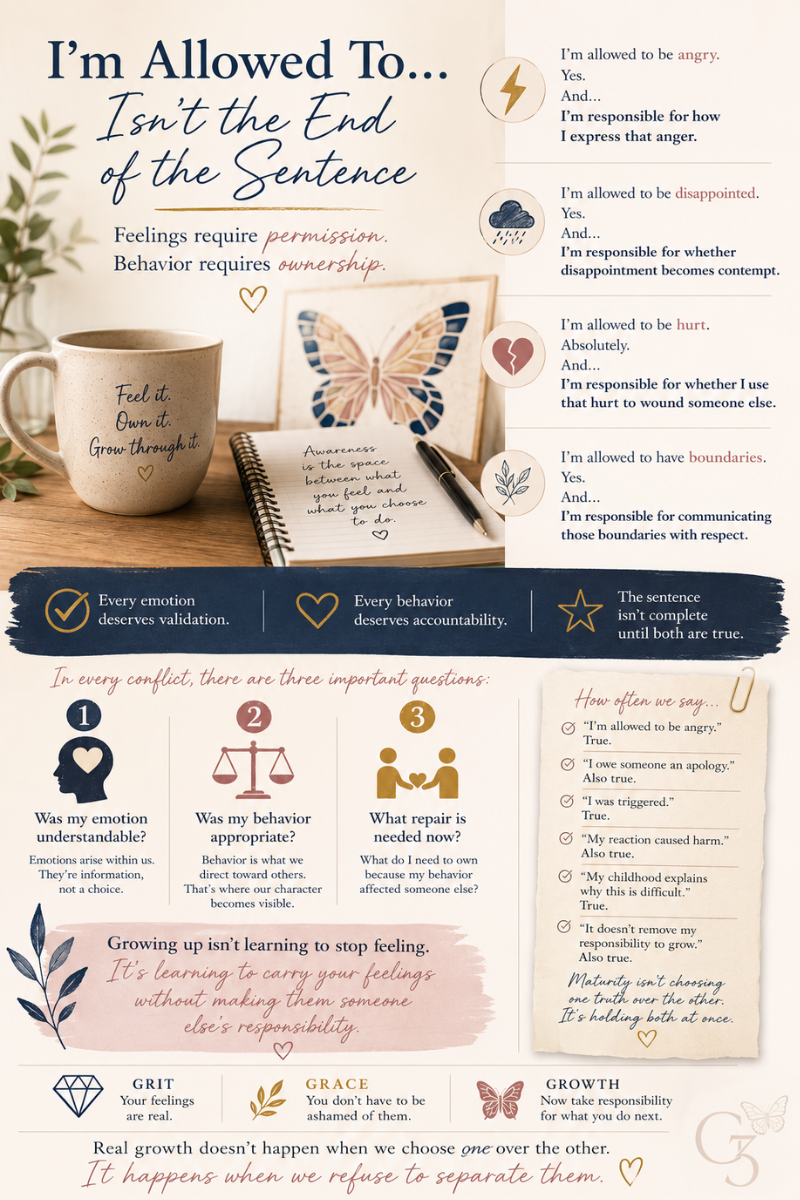
Feelings require permission. Behavior requires ownership.
Somewhere along the way, we learned to validate emotions. That was needed and important. For generations, people were taught to suppress, dismiss, or deny what they felt. Learning to say, “I’m allowed to feel this,” was healthy.
But somewhere along the way, many of us stopped the sentence too soon.
“I’m allowed to be angry.”
Yes.
And…
“I’m responsible for how I express that anger.”
“I’m allowed to be disappointed.”
Yes.
And…
“I’m responsible for whether disappointment becomes contempt.”
“I’m allowed to be hurt.”
Absolutely.
And…
“I’m responsible for whether I use that hurt to wound someone else.”
“I’m allowed to have boundaries.”
Yes.
And…
“I’m responsible for communicating those boundaries with respect.”
Notice the pattern?
Every emotion deserves validation.
Every behavior deserves accountability.
The sentence isn’t complete until both are true.
Choosing our conduct
When someone says, “I’m allowed to be angry,” they’re absolutely right. No one gets to police another person’s internal emotional experience.
But that’s only the first half of the sentence.
The complete thought sounds more like this:
“I’m allowed to be angry, and I’m responsible for what I do with that anger.”
Permission without ownership is incomplete. It also has the potential to harmful.
I’ve started thinking about it this way:
We don’t choose our emotions. We choose our conduct.
Emotions arise within us. Behavior is what we direct toward other people.
That’s an important distinction because feelings aren’t moral. They’re information. They tell us something about our experience, our needs, our fears, or our values.
Behavior, however, is where our character becomes visible.
That’s why saying, “I’m allowed to be angry,” can sometimes feel manipulative in the middle of a conflict. Whether intentional or not, it shifts the conversation away from the impact of our behavior and toward our right to have feelings.
Those aren’t the same conversation.
One is about permission.
The other is about responsibility.
Imagine this exchange:
Person A:
“You screamed at me.”
Person B:
“I’m allowed to be angry.”
Notice what happened.
The response doesn’t actually address the concern.
No one questioned whether anger was allowed. The issue was the screaming.
A healthier response might sound like this:
“I was angry. That doesn’t mean yelling at you was okay.”
One sentence validates the emotion.
The other owns the behavior.
Both matter. And both are needed.
3 questions per conflict
I’ve come to believe there are three separate questions in every conflict:
- Was my emotion understandable?
- Was my behavior appropriate?
- What repair is needed now?
Most people answer only the first question. Was my emotion understandable?
“Yes. I had every right to be angry.”
Maybe you did.
But Question 2 still exists. Was my behavior appropriate?
Did I handle that anger in a way that reflected the kind of person I want to be?
And so does Question 3. What repair is needed now?
What do I need to own because my behavior affected someone else?
Those questions don’t disappear simply because the emotion was legitimate.
Self-awareness isn’t just recognizing what you feel.
It’s recognizing the space between what you feel and what you choose to do.
That’s where character is formed.
Anyone can justify a reaction.
Emotionally mature people examine their response.
taking accountability
How often have we used one true statement to avoid a harder one?
“I’m allowed to be angry.”
True.
But the following is also true:
“I owe someone an apology.”
“I was triggered.”
True.
But, the following is also true:
“My reaction caused harm.”
The Take Away
Maturity isn’t choosing one truth over the other.
Contrarily, maturity is having the courage to hold both at the same time.
The most emotionally healthy people I know don’t stop at the first truth.
They finish the sentence by taking accountability.
Growing up isn’t learning to stop feeling.
It’s learning to carry your feelings without making them someone else’s responsibility.
You are absolutely allowed and entitled to be angry, disappointed, hurt, etc…
In fact, you are allowed to feel whatever is true for you.
However, the sentence doesn’t end there.
Grit says: Your feelings are real.
Grace says: You don’t have to be ashamed of them.
Growth says: Now take responsibility for what you do next.
That’s the balance we’re all trying to learn.
Not denying emotion.
Yet, not excusing behavior.
Simultaneously, honoring our humanity and our accountability.
Because real growth happens when we refuse to separate them.
Leave a Reply